-
 Red Blossom, 2022
 -
Minakshi, 2022
-
Sojourner Flex, 2021
-
Ikat Emerald, 2019
-
Avian Blush, 2021
-
Stranded in a sea of Eye Popping Poppies, 2023
-
Inspiral, 2023
-
Collar Up, 2023
-
Lotus Clouds, 2023
-
Slate Hand, 2023
-
Strike, 2023
-
Deep Dive, 2023
-
Stripes, 2019
-
Aïn II, 2024
-
Ayn, 2022
-
Blink, 2023
-
Dots II, 2019
-
Ikat Ruby, 2019
-
Peak, 2023
-
Red Blossom, 2022


-
Alia Ali: Introducing Alia Ali | Gilman Contemporary
Maria Movsesyan, Musée Magazine , 19 January 2026 -
People of Pattern
What do our chosen fashions, fabrics and clothing say about us as individuals — and how does this affect the attitudes of others towards us?Lensculture -
Why Yemini Artist Alia Ali is One to Watch
Aidan Imanova, Architectural Digest, 30 May 2024 -
Alia Ali Ambassador—Multi-media Artist and Fine Art Photographer
Alia is a Yemeni-Bosnian-US multi-media artist, and graduate of Wellesley College and the California Institute of the Arts.Nikon , 6 February 2024



-
10 Questions With... Alia Ali
Aesthetica Magazine, 7 December 2023 -
Emerging and Submerging: The Push and Pull of Visibility in Alia Ali’s “Blue Note”
Rosa Boshier González , Glasstire, 14 November 2022 -
An intergalactic journey through the works of Alia Ali, with fabric that dresses and reveals the body, identity and connections.
The ongoing projects and exhibitions of the Yemeni-Bosnian-American artist who questions lies and certainties, dressing our physical and emotional connections.Simona Marani, Elle, 24 November 2021 -
Alia Ali’s Yemeni Futurism
From her earliest works, Ali has confronted colonial histories, challenged racial and gendered biases, and put pressure on borders both physical and conceptual.Jad Dahshan, Hyperallergic, 22 May 2021


-
Blinding The Imperial Eye And Visioning Ancient Futures: The Work of Alia Ali
Jad Dahshan, Artmejo, 8 May 2021 -
Cultural Identity Seen Through the Politics of Thread
For her project, photographer Alia Ali communicated with textile artists who live in communities whose borders have been marked “by imprints of power and scars of destruction.Lizzy Vartanian Collier, Hyperallergic , 15 April 2019 -
Alia Ali
Ours, 12 June 2017


We arrive and strive to be like them... only to discover that we can never be anyone else than ourselves.
My work is dedicated to those hidden in plain sight — the migrants. It is a reminder of our royalty that once was, and still is, the beauty in our color, the poetry in our narratives, and the song in our accents.
If we are not honored by others, then we have the power to honor each other.
My work is dedicated to (you/us).
-Alia Ali
Alia Ali (b. 1985, Austria) is a Yemeni-Bosnian-US multi-media artist whose work explores cultural binaries and confronts conflicted notions surrounding gender, politics, media, and citizenship. Working between language, photography, sculpture, video, and installation, Alia’s work addresses the politicization of the body, histories of colonization, imperialism, sexism, and racism through projects that take pattern as their primary motif.
Textile, in particular, has been a constant in the artist's practice. Her strong belief that textile is significant to all of us, reminds us that we are born into it, we sleep in it, we eat on it, we define ourselves by it, we shield ourselves with it, and eventually, we die in it. While it unites us, it also divides us physically and symbolically. Her work broadens into immersive installations utilizing light and pattern to move past language and offer an expansive, experiential understanding of self, culture, and nation.
Alia’s practice expands into discourses of Yemeni Futurism where she offers counter-narratives to appropriation, violence and disregard. Her research calls upon oral histories to reframe nostalgic pasts and to confront dystopian realities of the present in order to carve out spaces for radically imagined futures.
Alia Ali is a graduate of Wellesley College (Political Sciences and Studio Art), the California Institute of the Arts (Photography and Media), and is a NIKON Global Ambassador. Her work has integrated the permanent collections of The British Museum, Museum of Contemporary Photography Chicago (MoCP), New Orleans Museum of Art (NOMA), and Princeton University, among others. Her monument "al-Falak" was funded by the Andrew Mellon Foundation and now sits at the Arab American National Museum. Her work has been featured in publications including Vogue, Harper’s Bazaar, Architectural Digest, and the Financial Times. Alia Ali's works and lives in and between New Orleans, Paris, Marrakech and Jaipur.
-
Alia Ali
Threadlines 1 - 31 July 2026With roots in Yemen, Bosnia, and the United States, Alia Ali’s artwork explores themes of identity, displacement, transnationalism and migration through photographs that blur the line between portraiture and abstraction.Read more -
Alia Ali
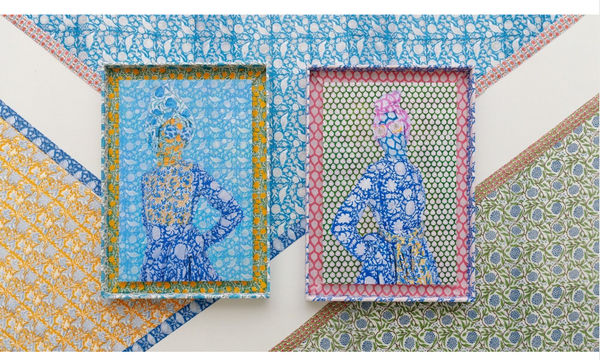
Introducing Alia Ali 8 December 2025 - 21 January 2026Gilman Contemporary introduces the work of Alia Ali, an artist with roots in Yemen, Bosnia, and the United States. Ali explores themes of identity, displacement, transnationalism and migration through photographs that blur the line between portraiture and abstraction. Figures are enveloped in vibrantly patterned cloths that obscure identifying characteristics. Every portrait is presented in a hand-upholstered frame, crafted from the same fabric depicted in the photograph, extending the work beyond its visual borders.Read more

